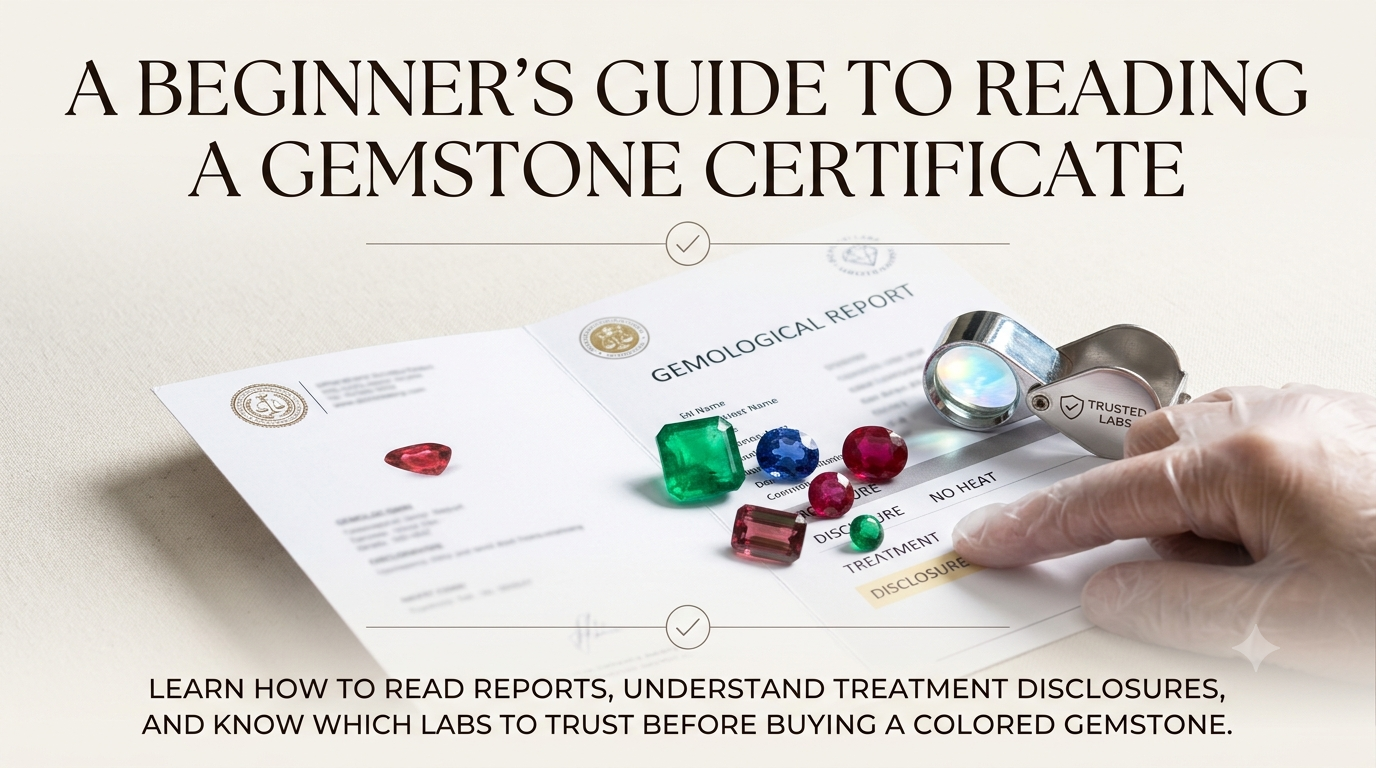
A Beginner's Guide to Reading a Gemstone Certificate
If you've ever shopped for a colored gemstone or a diamond, you've probably come across a certificate — a document from a gemological lab that lays out the details of the stone in front of you. These reports can look intimidating at first glance, full of abbreviations and grading scales, but once you know what you're looking at, they become one of the most useful tools you have as a buyer.
What a gemstone certificate actually is
A certificate is an independent report from a gemological laboratory confirming what a stone is and describing its characteristics. It is not an appraisal and it does not set a price — its job is simply to document the facts about the gem so you know exactly what you're buying, regardless of who is selling it.
The basics: identity and origin
Every certificate starts with the fundamentals: what the stone actually is (sapphire, tanzanite, garnet, and so on), and in many cases, where it came from. Origin can matter a great deal for value — a Kashmir sapphire or a Burmese ruby, for example, often carries a premium purely because of its source. Not every lab determines origin, and not every stone has a determinable one, so don't be surprised if this field is left blank on some reports.
Treatment disclosure
This is arguably the most important section on the whole document. Most colored gemstones on the market have been treated in some way to improve their color or clarity — heating is extremely common and widely accepted, while treatments like clarity enhancement, diffusion, or dyeing are more significant and should always affect the price you pay.
A trustworthy certificate will clearly state whether a stone is untreated, heated, or treated using another specific method. If a certificate is vague about treatment, or a seller can't explain what the wording means, that's worth asking more questions about before you buy.
The 4 C's — and how they apply beyond diamonds
You've likely heard of carat, color, clarity, and cut in the context of diamonds, but the same basic framework applies to colored gemstones, just with different emphasis.
- Carat weight: the stone's weight, measured in carats, listed to two decimal places on most reports.
- Color: for colored stones, this is usually described in words — hue, tone, and saturation — rather than the letter-grade scale used for diamonds.
- Clarity: how clean the stone is internally. Many colored gemstones naturally include some inclusions, and this isn't necessarily a flaw — it's part of what confirms the stone is natural rather than lab-created.
- Cut: the shape and faceting style, along with proportions that affect how well the stone reflects light.
Measurements and shape
Certificates list precise measurements in millimeters — length, width, and depth — along with the cutting style, whether that's round brilliant, emerald cut, cushion, or a more unusual custom shape. These numbers are useful if you're having a piece custom set, since your jeweler will need exact dimensions to design the setting around the stone.
Which labs to trust
Not all certificates carry the same weight. Established, independent laboratories with a long track record of consistent grading are generally viewed as more reliable than reports issued by a seller's in-house lab, since independence removes the incentive to inflate a stone's qualities. When you're comparing two similar stones, it's worth checking which lab issued each report, not just what the report says.
Putting it all together
A certificate won't tell you whether a stone is beautiful — that's something only your own eyes can judge — but it will tell you whether what you're looking at matches what you're being told. Before buying any significant colored gemstone, it's worth asking to see the certificate, reading the treatment section carefully, and asking questions about anything that isn't clear. A seller who's happy to walk you through the document is usually a good sign in itself.